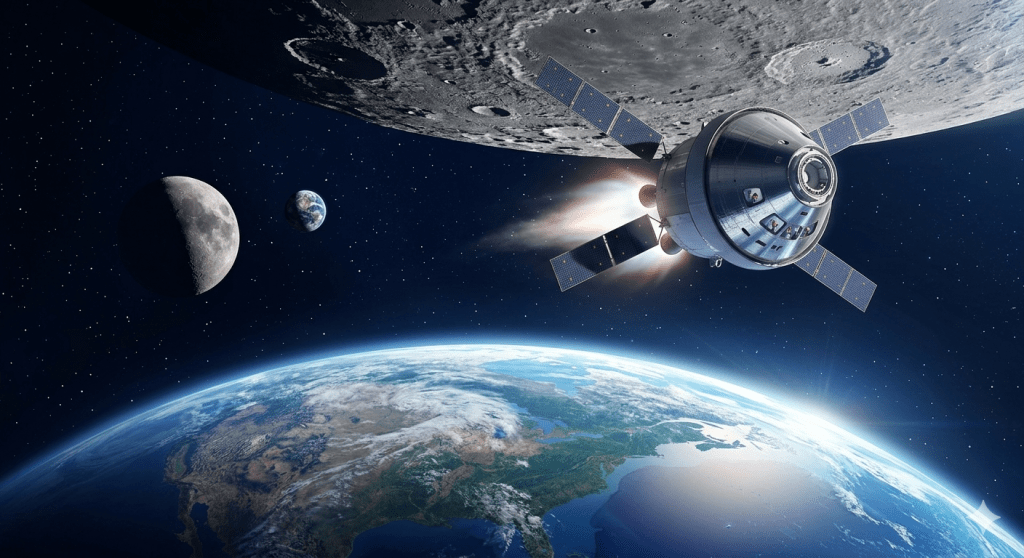
Wednesday evening, a remarkable thing happened: NASA’s Artemis II mission successfully lifted off from Kennedy Space Center. While they aren’t landing on the lunar surface on this trip, the crew is currently in Earth orbit, performing critical system checks before they make the “burn” toward the Moon.
To me, this is our generation’s attempt at a “John Glenn orbiting the Earth” moment. But more than that, it is a staggering display of The Audacity of Potential. It is the “what if” made manifest in steel and fire. It’s the first real step toward Mars, and I still hold out hope that I’ll see a human footprint on the Red Planet in my lifetime.
No More Breadcrumbs
There is a statistic that keeps me up at night: only 66 years passed between the Wright Brothers’ first flight in 1903 and the Apollo 11 landing in 1969. And yet, it has been 53 years since humans last left Earth’s orbit.
As a child of the 80s, the Space Shuttle program defined my view of the stars, but looking back—especially after seeing documentaries on the Challenger explosion—it feels like we spent decades accepting “breadcrumbs.” We stayed in low Earth orbit, settling for small wins while the horizon stayed out of reach. This launch feels like NASA finally choosing Option C—refusing to settle for the status quo and choosing the harder, bolder path.
A Horizon for Everyone
This mission is a sign of the times in the best way possible. The crew—including Christina Koch, Victor Glover, and Jeremy Hansen alongside Commander Reid Wiseman—represents a shift. The Apollo era used slogans like “we came in peace for all mankind” while planting a U.S. flag. This time, the “Tricorder perspective” of using modern, inclusive tools to navigate a deeply personal (and global) journey is front and center. Representation matters because the “potential” we are exploring belongs to everyone.
The “Concrete” Stats:
• The Power: The Space Launch System (SLS) rocket generated 8.8 million pounds of thrust—15% more than the Saturn V.
• The Record: The crew will travel 4,700 miles beyond the far side of the Moon. At that point, they will be more than 250,000 miles from Earth, officially breaking the distance record for humans in space set by Apollo 13 in 1970.
• The Status: The crew is testing life support and manual piloting today. They are expected to reach the Moon in about four days.
If I were on that ship, I’d have to bring a baseball and a bat. Just so when we finally hit Mars, I could swing for the fences and say, “I just played the first game of baseball on another planet.”
Until then, I’ll take this win. It’s a breath of fresh air in a world that’s felt a little too crowded lately. It’s proof that when we stop accepting breadcrumbs, the audacity of what we can achieve is limitless.
Thanks for stopping by Rebuilding Rob. Be sure to like 👍, comment and subscribe below. It’s greatly appreciated! Also, feel free to follow I’m me on social media and check out my recent posts!
- Artemis II: The Audacity of Human Potential
- Episode 7: The Teacher Armor is now LIVE!
- The Single Screw
- April: The Season Opener
- 134 – 1: Michigan is the Lone Survivor of My 2026 March Madness Bracket
AI art created with Google Gemini
The article “Artemis II: The Audacity of Human Potential” first appearance on Rebuilding Rob

 Rebuilding Rob
Leave a comment