In January 1995, Star Trek Voyager premiered as the flagship program of the new UPN television network. The show which premiered following the end of Star Trek: The Next Generation, hereafter referred to as TNG. …Voyager was a show of many firsts. As most of you may know, it was the first Star Trek series to feature a female captain.
In an attempt to shake up the status quo of the Star Trek franchise, it was decided that the premise of …Voyager would be a ship stranded thousands of light years from Federation space. If the original Star Trek was “A wagon train to the stars” and Deep Space Nine was “Fort Laramie” in space, Voyager would be…Gilligan’s Island.
Just for the record, I wanted to like Star Trek Voyager. I really gave it a chance. There were several reasons that I did not care for the show. Some of these assessments were things I noticed immediately back in 1995 when the series premiered. Others are instances of me looking back on the show through 2024 lenses, so bear with me.
Despite the fact that what Rick Berman and Company had created should have been a serialized television show, the network executives at UPN insisted that voyager be episodic, not unlke Star Trek and Star Trek The Next Generation. After all, those shows were hit. Why wouldn’t the same format work with Voyager?
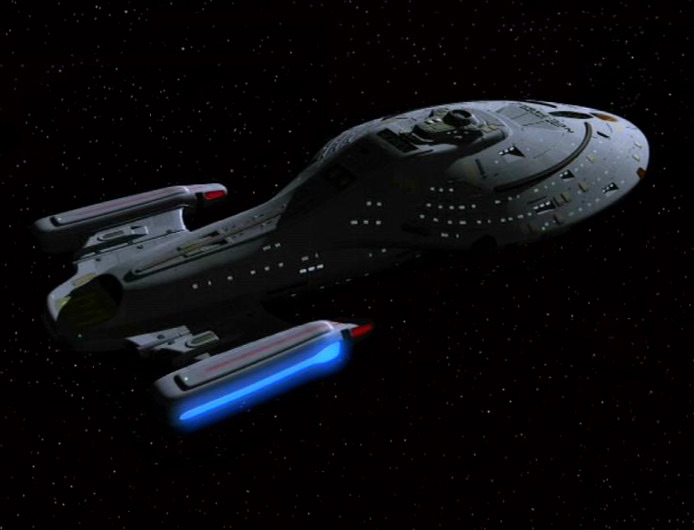
As I mentioned, Voyager’s premise should have dictated that the show be serialized. As viewers, we should have seen complications and damages to the ship that would have lasting side effects throughout the run. If this was the only federation ship in this part of the galaxy, they would have a finite number of photon torpedoes.
Once those torpedoes are gone, they are gone. When crew members die, there would be no new recruits who could transfer to the ship and take over a post. It’s been established throughout the franchise that Starfleet crew members can be quite ingenious when necessary. However, the very nature of Voyager, being a light duty starship thousand of lightyears from a Federation space make the notion of crew members performing heavy duty construction creates a prolonged suspension of disbelief, even for sci-fi fans. Were we really supposed to believe that the crew could construct new photon torpedoes, let alone an enhanced shuttle like the Delta Flyer?
To make matters worse any time that the ship was attacked, things were returned to their proper working order by the next episode. No sparking computer consoles, no rubble (where the Hell did those ROCKS come from anyway?!). The series’ one saving grace in this regard was the two-part “Yea of Hell” story. during the two-parter, we saw the condition of voyager continual to deteriorate. As good as”Year of Hell” was, the original concept, for the episode would’ve been even better. Rather than just a two-part episode,… Hell was originally intended to be a season-long story arc.
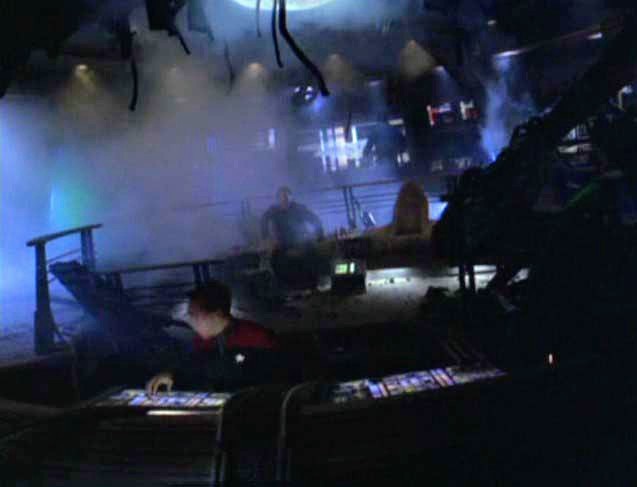
Even many longtime fans were disappointed with “endgame“ the series finale. Voyager was only seen approaching earth in the very last shot of the episode. I think many fans were hoping to get at least a few episodes. Dealing with Voyagers, returned to the Alpha quadrant and getting some final resolution for the main cast.
Myself, I could not stand the heavily convoluted time travel story that resulted in the ship, returning home. Apparently, the voyager writers decided to adopt the Bill & Ted’s Excellent Adventure rules of time travel. The ship had to get home in order for Janeway to decide that she would travel back in time to get the crew home quicker.
I probably would’ve written almost every character differently.
What made the character who re originally Marquis crew join the Marquis in the first place? What was their motivation? Early on, we saw some characters who were more loyal to Chakotay than they were Captain Janeway. In the defense of the show, it does make sense that that loyalty would eventually wane.
I would given more of the main characters back stories through flashback. So much so in fact, that I could have boiled the entire series down to the idea that “the real journey lies within”. Had they gone in this direction, it probably would not have even mattered of they ever made it back to the Alpha Quadrant.
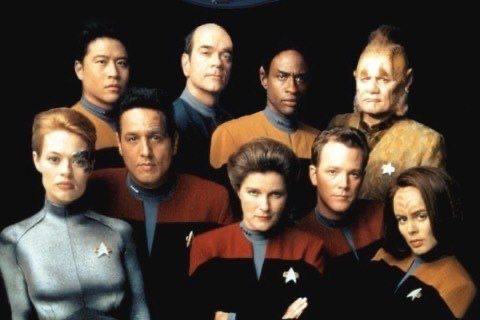
Lt. B’elanna Torres
to that end, I think that B’elanna Torres was probably the most poorly utilized character on the show. She could’ve been very much the antithesis of perhaps the most beloved character of the entire Star Trek franchise, Spock. As a half human, half Klingon, Torres was often at odds with her human sensibilities and her Klingon impulsiveness. As it was depicted on the show, Torres typically chose to ignore her Klingon tendencies. Aside from the fact that she had a semi bumpy forehead, viewers might even forget that she was in fact, Klingon. she could’ve been very much like Spock was on TOS, conflicted character, who struggles with two different sets of instincts and ideologies. Would this seem too derivative of TOS? Probably. But I think it would’ve made for much more entertaining character.
Lt Tom Paris
As for Lieutenant Tom Paris, I’ve heard widely differing stories as to why his character was created; rather than just recycling, Nicholas Locarno, whom Robert Duncan McNeil played on the TNG episode “the first duty“. I wish we would’ve gotten more on the accident that caused Paris’s fall from grace. Knowing the details of whatever got him imprisoned could have made viewers sympathize with him more.
Producers said that the Locarno character was “irredeemable” and that why the decision was made to create Paris but I think the series could have served as the ultimate redemption arc for him. Something similar could have been down with Paris. Alas, Paris was a bland as the PB&J sandwiches he ate.
Lt Commander Tuvok
I don’t know that I really would’ve changed much about the way Lieutenant Tuvok was written. We got some pretty good insight into the Vulcan culture through him, but it would’ve been nice to have gotten more. I was shocked that we got a Pon Farr episode (Think TNG’s “Amok Time”) about a one-off Vulcan character rather than Tuvok himself. Again, why should we care about this one-off character? Tuvok being the connection to the TOS era, as seen in “Flashback” was no-brainer, but fun nonetheless.
Chakotay
Our first officer, Chakotay. I like the idea that he was a Native American in the 24th century. But as i will say with all the Maquis characters, why did he leave Starfleet? What his career like before resigning? His dynamic with Janeway was…confusing. Sometimes romantic. Sometimes platonic. Sometimes subservient. Sometimes a trusted confidant. Sometimes an emasculated rival. Like so many other main cast members, his role was diminished as the show started to focus on Seven, The Doctor and Naomi Wildman. Early on, he was portrayed as a go-between for the crew and Janeway. Likewise, he was also cast as Janeway’s conscious; albeit one she usually ignored
Kes
When I first started giving thought to this whole thing, I thought that Torres was the most sorely under utilized character of the main cast. However, after further consideration, I think that dubious distinction has to fall to the character who was written out halfway through the series, Kes. That fact alone qualifies her as the most under0utilized character in the series, but there’s more.
As an Ocampan who lived in a Delta quadrant, Kes and her species were new to the Star Trek franchise. The idea behind the character, and her race, for that matter, was a fascinating one. Ocampans live very short lifespan 7 to 8 years, as I believe was initially said on the show. I think the writers could’ve used this to show the most well-planned out story arc of any character in the entire franchise.
As Voyager begins, Kes, it is said, is two years old; or roughly equivalent, to a young woman in her 20s. The writers could’ve taken this character basically through her entire life over the course of seven seasons as she approached middle-age and eventually, with old age and facing death. What could’ve possibly been a better story than showing a character going through every stage of life? The writers shit the proverbial bed with Kes, and did actress Jennifer Lein dirty.
Seven of Nine / Annika Hansen
At some point before Jeri Ryan joined the cast in season four as seven of nine, rumor has it that a directive came down from network to get rid of one of two characters: either Harry Kim, or Kes. Obviously, Kes got the axe.
Historically when a new character is introduced in the middle of a series, it’s meant to inject some new life into the show. I don’t anyone would argue that …Voyager needed some new creative juices. I think it’s a tall enough task for any actor who joins the cast of an existing show midway through the series., Adding a new regular cast member is a sign that the show is floundering; and the writers need to inject a new blood in order to get some new ideas. From the skin-tight catsuit that Jeri Ryan had to wear as Seven, it’s obvious that the character was brought in strictly as a T & A element.
To be honest, I really don’t have any issues with Seven’s story series. I think the writers tried too hard to portray her as “an ice queen” in the beginning, and gradually had her mellow out. I would have scrapped the romantic storyline between her and Chakotay near the end of the series as that came out of left field.
One of my fundamental problems with the 7 of 9 character has nothing to do with the character or how Jeri Ryan played her, It is the fact that she was “unassimilated” from the Borg collective against her will. If you recall those early season 4 episodes during her introduction, she wanted to remain Borg. I remember, in the best of both worlds, part one, Captain Picard tells the Borg, that humans value “freedom and self-determination“. How hauntingly ironic is it that Captain Janeway insisted on reverting Seven back to her human form against her will
Ensign Harry Kim
I’m going to go ahead and say it: seven years later, and he was still an Ensign. I liked the idea that in Harry, we were going to see a Starfleet officer at the beginning of his career. Early on, he was also portrayed as the character most eager to return to the alpha quadrant. He started as the homesick kid; and ended the series as …the homesick kid. I don’t know that we ever really saw a lot of growth in him as a character, however. we learned he played the clarinet, and then he always struck out with women. I like the idea of pairing him up with Lieutenant Paris in a Bromance. But that’s really about all they ever gave actor Garret Wang to work with on the show.
Neelix
The less said about Neelix, the better. Nothing against Ethan Phillips, who I think is a really good actor, but this character was just cringe. When Kes was still on the series and the two were involved in relationship, Neelix was horribly insecure. That is not a very flattering trait for one of our protagonists.
Once Kes was written out of the show, Neelix got an opportunity to step out over shadow. No longer was he just the jealous boyfriend. The show began to shift focus to seven and the doctor, Neelix complimented the two characters, as well as the recurring character Naomi Wildman very well.
I did like that shortly before the series finale, as the crew ran into one more colony of Talaxians, Neelix decided to stay with them. In fact, that last episode with Neelix was one of my favorite stories of the character. It’s not that I hated the character so much; rather, it made sense that Neelix would choose to remain behind in the Delta Quadrant once Voyager reached a certain point on her journey.
The Doctor
The only complaint I have about the doctor is that writers leaned too heavily into him as the series progressed. Robert Picardo is an amazing actor and a holographic person generated a bunch of story possibilities. The Doctor served in very much the same storytelling capacity as Data did for Star Trek: The Next Generation. Both characters were vehicles for exploring the human condition for the respective shows. In the end, the Doctor was too often the focus for Voyager’s episodes. They could’ve told a few more stories in which they gave the human characters the spotlight as well.
Captain Janeway
Where do i possibly begin?
I think my biggest problem with Janeway is that the character felt so hell-bent on constantly proving not only how tough she was but how unpredictable she could be and fans ate this up, citing as some “strong independent woman”! This characterization was essentially a female Kirk for safe-sex 1990s television audiences. Sexual bravado aside, Janeway embodied all of the same characteristics that made Captain Kirk an arrogant douche thirty years prior.
I never liked the character. Admittedly, I haven’t seen every episode of Voyager, but often times, I got the impression that she kept her senior staff “in the dark” far too often.
I commend Rick Berman, Michael Piller and Jeri Taylor for putting a woman in the lead role, but maybe the premise of Voyager wasn’t the best option to have the first female captain as a series regular in the franchise. Janeway was basically in “survival mode” for the duration of the series. In Janeway’s defense, we probably did not get the opportunity to see the character at her best.
The terrible truth is that men and women think differently than one another. Neither is better nor worse than the other. They’re just different. The circumstances established in Voyager’s premise are, admittedly going to make people act out of character. I was just never a let to sympathize with the character.
FINAL TAKE: the truth is, I just did not care for Star Trek Voyager. My greatest issues with the show lay with perceived greatness of the Captain Janeway character. However, I think I’ve also pointed out that I would’ve gone with a different take of basically every single main cast member.
The show’s premise, while presenting a unique opportunity for the show runners, also became one of its greatest obstacles. This complete separation of all things to Star Trek franchise had established for the previous 30 years was also compounded by the network insistence on an episodic series.
Admittedly, I have seen maybe only slightly more than half of the series. I think, in order to give a truly accurate assessment of the show, I do need to go back and watch the remainder of the episodes that I have yet to see.
Thanks for stopping by Rebuilding Rob. Be sure to like, comment and subscribe to my blog below. It’s greatly appreciated! Also, feel free to follow me on social media as well! Check out my most recent posts as well as some earlier, related posts:
- Sunday is borrowed time
- Teacher Armor and the Saturday Clearing
- The Extra Day: A Ten-Year Memory
- Of Training Wheels and Christmas Lights
- Charity Starts at Home (And I’m Back in My Childhood One)
The article “A Condemnation of Star Trek: Voyager – A Rob Review” first appeared on Rebuilding Rob


 Rebuilding Rob
Leave a comment