As WordPress continues to recycle old prompts, I pulled another prompt from The Coffee Monsterz Co to respond to today
What is something that has gotten better with added tech features? What has gotten worse?
I think that smartphones have gotten better with additional tech features. One can certainly make the argument that smartphones are too distracting and cause too many mental health problems, particularly for young people. They do.
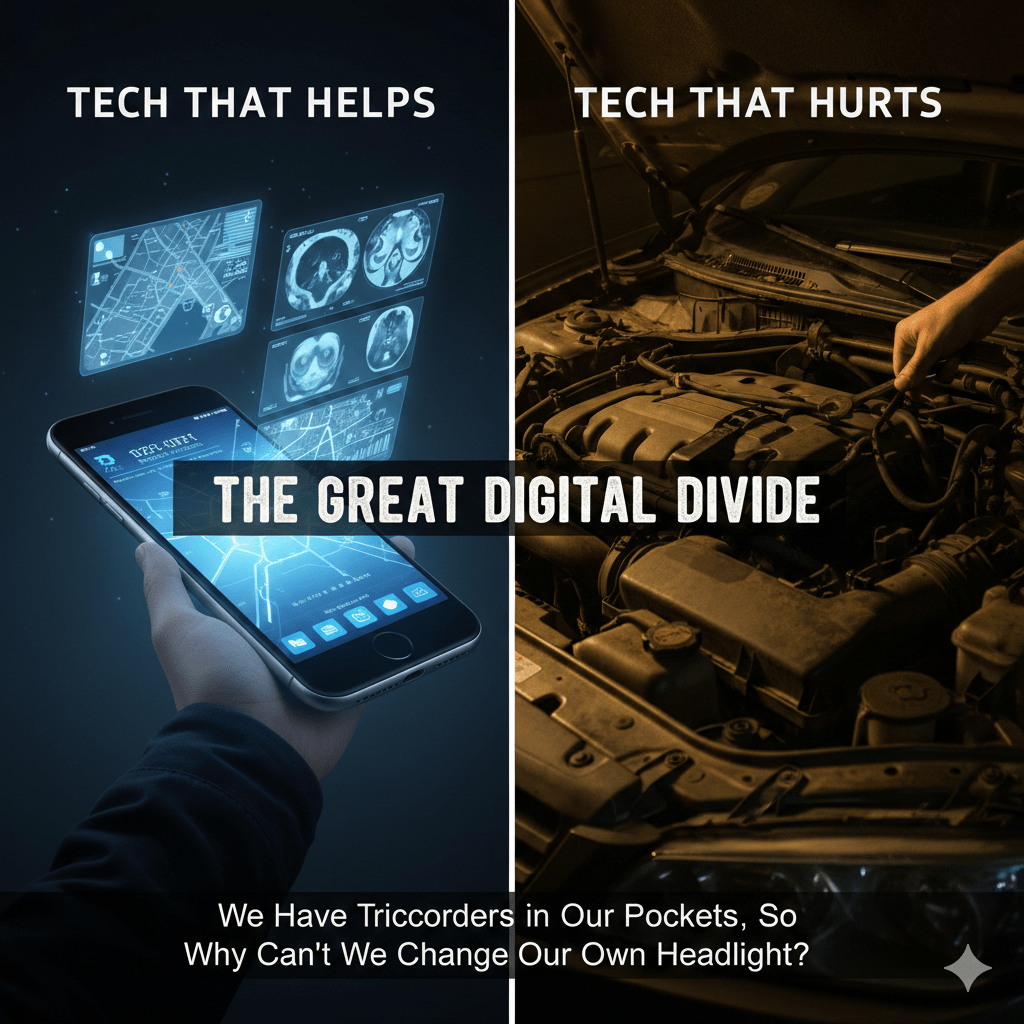
Essentially, smartphones have become our real-life versions of the tricorder—the handheld computer device used by characters on the various Star Trek shows.
Personally, I’m even reluctant to call smartphones “phones” anymore. They are essentially small computers. And while I take the technology for granted on most days, I have to remind myself that our current smartphones have more memory, more storage space, and faster processors than the computers that were used to land the Apollo rockets on the moon.
The Key Difference: Empowerment vs. Dependency
The key difference is how this technology serves us. The smartphone—our modern-day Tricorder—is a gateway to knowledge that empowers the user. It puts the tools of the universe in our pocket.
Conversely, when we look at the modern car, we see technology being used to lock the user out. Instead of making our lives easier, it makes simple tasks impossible and forces us to be dependent on complex, costly, and sometimes unreliable systems.
I’m sure I’ll probably get torched for this, but one thing that I think has actually gotten worse as it has become more technical are cars. Let me explain: no, I’m not the kind of guy who still wants to drive a manual transmission car without power steering.
My big issue with cars is the fact that virtually every car has some sort of onboard computer, even if it’s just a motherboard with some memory chips. Some of the technical features that come with cars being more computerized are great, in theory. The trouble is, sometimes things like automated sensors that measure the air pressure on your tires can go faulty. They may give you an inaccurate reading on your tire pressure or no reading at all.
American cars built over the last few years often have a feature that will cut off the car engine when you’re at a dead stop, as opposed to letting the car idle. This is supposed to reduce emissions and be more fuel efficient. The problem with this feature is that the constant starting and stopping of the car is beginning to affect some of the starter components in some vehicles.
The Lost Work Ethic
When The Old Man was young and early on in his adulthood, he didn’t have a lot of money. Because of that, he couldn’t always afford to take his car to a shop to get it fixed. He had to learn how to fix things himself. Keep in mind, he did this without the benefit of YouTube or the Internet.
I like to think that I’ve taken on a little bit of that hands-on work ethic. Whenever I can, I try to fix things myself, partially as a cost-saving measure. But some of the recent innovations in cars have made that very difficult.
For instance, it’s much more difficult to open up the hood of a car to change a battery or even change a headlight bulb than it was in a car from 30 years ago. This is largely because car manufacturers have to meet strict fuel efficiency standards while still offering large vehicles, forcing them to narrow and cram parts together.
Conclusion: The Divide
The Old Man learned to fix his car out of necessity, using his own hands and a manual. That kind of hands-on self-reliance is exactly what the modern, over-engineered car has all but eliminated.
It’s interesting to note that my father, despite being highly tech-savvy—his second career dealt almost entirely with digital photography—never owned a smartphone. Having passed away just over ten years ago, he was certainly alive during the rise of these devices, but he simply refused to own one. Beyond the security risks of having all your personal information on what was essentially a computer in your hands, he didn’t like the idea of people being able to contact him in any given moment.
He rejected technology that infringed on his personal autonomy.
Ironically, if The Old Man were starting today, his smartphone—the “good” technology I praised earlier—would be the only tool that could possibly help him figure out how to open the hood and replace a headlight bulb on a new car. The smartphone empowers us to learn; the complex car disempowers us to do. That is the divide we need to address in our accelerating technological world.
Thanks for stopping by Rebuilding Rob. Be sure to like, 👍 comment and subscribe to my blog below. It’s greatly appreciated! Also, feel free to follow me on social media as well! Check out my most recent posts as well as some earlier, related (and perhaps, not-so-related) posts:
- The Cruelest Way to Say It’s Over: The “Alpine Divorce”
- The Math of the 26-Hour Day
- Rob Reviews: Daredevil Born Again 2.6 “Requiem”
- Rob’s Retro Review: Blade Runner (1982)
- Someday is This Summer: A Wake-Up Call at 52
AI art created with Google Gemini
The article “Tech That Helps, and Tech That Hurts: The Great Digital Divide” first appeared on Rebuilding Rob



 Rebuilding Rob
Leave a reply to MyGenXerLife Cancel reply