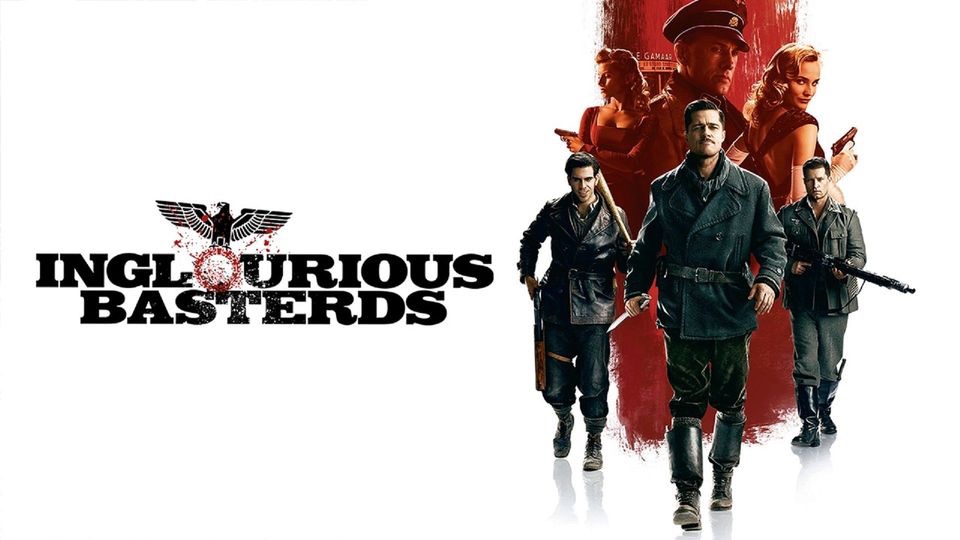
When Kid One was in town for the Christmas holiday last week, he informed me that he had watched Pulp Fiction and considers himself a big fan of Quentin Tarantino. To that end, I had him watch Reservoir Dogs, which I reviewed HERE. Immediately afterward, he insisted that I watch Inglourious Basterds. I’m glad I listened to him, because it reminded me that while Tarantino loves his dialogue, he loves a good explosion of chaos even more. In turn, I decided to review this movie as well.
Inglourious Basterds is writer-director Quentin Tarantino’s combination of a revenge story, a spaghetti western, and a war movie all rolled into one. While there were several historical accounts of plots to kill Hitler and other high-ranking Nazi officials, Tarantino definitely takes a “revisionist history” slant with this story. If you’re familiar with Tarantino‘s work, you probably have a pretty good idea of how it goes.
The film is actually two revenge stories running concurrently. The first being that of Lt. Aldo Raine (Brad Pitt) and his military unit, the Basterds. The titular Basterds are waging their own take-no-prisoners war against any and all Nazis they encounter.
The Audacity of Two Fronts: Aldo vs. Shosanna
While the film is an ensemble piece, the heart of the movie beats through two incredibly bold plans that run on parallel tracks. On one side, you have Lt. Aldo Raine. Brad Pitt doesn’t just play this role; he attacks it. It is a performance defined by “chewing the scenery” in the best way possible. From his jutted-out jaw to the way he leans into every syllable of the word “Nat-zi,” Pitt plays Raine as a man who is fully aware he is the hero of a tall tale. He is the blunt force—the loud, Southern-fried presence that tells the enemy exactly who is coming for them.
Then, there is Shosanna Dreyfus.
If Aldo is the sledgehammer, Shosanna is the slow-burning fuse. Her approach is, in many ways, more impressive because it is fueled by a quiet, disciplined rage. She doesn’t have a squad of soldiers or a cache of machine guns; she has a cinema, a pile of flammable film stock, and the patience of a ghost. Her resolve is especially striking considering she has to share the screen with the terrifyingly polite Col. Hans Landa, the man responsible for her family’s death.
The brilliance of the film’s climax is that these two forces—the loud and the silent—never actually coordinate. They are both operating on the same raw potential, believing they can single-handedly end the war in a night. Shosanna’s plan is surgical and personal; Aldo’s is chaotic and theatrical. Watching them collide in that final act is a reminder of why we go to the movies: to see the “unexpected win” play out in the most stylish way possible.
The Ultimate Revision
The ultimate “unexpected win” here isn’t just that the protagonists survive—it’s that Tarantino has the nerve to rewrite the history books entirely. I’ll be honest: going into this, I knew I was in for a blood-and-guts revenge flick, but I still expected it to maintain some level of historical accuracy.
When the ending ultimately came about and Hitler was killed in such brutal, cinematic fashion, I was stunned. And yet, looking back at the two hours of build-up that led to it, I wasn’t the least bit surprised either. It’s the peak of narrative storytelling: the idea that through film, we can provide a more cathartic ending to one of history’s darkest chapters than the one we find in the textbooks.
FINAL VERDICT
Inglourious Basterds is a rare breed of film that manages to be both a tense historical thriller and a loud, unapologetic celebration of cinema itself. It succeeds because it doesn’t try to play it safe. Whether it’s the agonizingly long, dialogue-heavy scenes that stretch tension to a breaking point, or Brad Pitt’s delightfully over-the-top performance, every frame feels intentional.
It’s a movie that asks the audience to embrace a “what if” scenario and rewards them for it with a climax that is as cathartic as it is chaotic. While some might find the historical revisionism jarring, I find it incredibly refreshing. It’s a testament to the power of fiction—the idea that even when history is written in stone, the movies can still find a way to give us the win we didn’t know we needed.
Final Thought: If you’re coming for the history, you’re in the wrong theater. But if you’re coming to see a masterclass in tension and a version of Brad Pitt that is clearly having the time of his life, Inglourious Basterds is an absolute must-watch.
Thanks for stopping by Rebuilding Rob. Be sure to like 👍, comment, and subscribe below. It’s greatly appreciated! Also, feel free to follow me on social media and check out my recent posts!
- Rob Ranks: Star Trek: Strange New Worlds, season 2
- Beating the Bell
- Out of the Woodwork
- Episode 3.8 Too Dumb To Quit is LIVE!
- Why Now? (And What Star Trek Got Wrong About First Contact)
The article “Rob Reviews: Inglorious Basterds (2009)” first appeared on Rebuilding Rob



Leave a Reply