

My choice for a TV series that had the perfect finale might seem a little biased because I am such a hardcore nerd, but I would make the argument that the final episode of Star Trek: The Next Generation, “All Good Things…”, was the perfect series finale. Even the title itself is just kickass. It’s elegant, a little poetic, and perfectly sets the stage for a story about time, legacy, and saying goodbye.
Growing Up with the Enterprise
As a fan of TNG from day one, this show is part of my DNA. I was a lonely, socially awkward kid in junior high when it premiered in 1987. By the time it ended in 1994, I was 20 years old and entering the peak of my life. In a lot of ways, the show grew up with me.
To give you an idea of how deep it goes: I remember being on spring break in Florida with some friends in the early 90s. We were hanging out in a timeshare, and I turned on the TV to find a rerun of TNG. A couple of guys in the group started laughing at me, saying, “Rob! We’re in Florida on spring break!” My response was simple:
“I could be dead, and I will still make time to watch Star Trek: The Next Generation.”
“All Good Things…” is the hill I will die on. Let me explain why.
The Ultimate Trial for Humanity
First and foremost, the story had epic stakes. The finale sees Picard’s greatest antagonist, Q, return. The plot serves as a perfect bookend to the series premiere, “Encounter at Farpoint,” in which Q also first appeared. The narrative forces Captain Picard to shift through time across three eras: seven years in the past (roughly the start of the series), the present, and a future 25 years later.
Picard is brought back to the same 21st-century, post-apocalyptic courtroom seen in the premiere, with Q once again serving as judge. He tells Picard that the trial humanity was placed on seven years ago never actually ended—it is simply reaching its conclusion. He claims humanity is guilty and reveals that Picard himself is about to cause the annihilation of the human race. Q is characteristically vague, reminding Picard that he has done it before, and he will do it again.
Because of the time-travel element, we get some fantastic callbacks to the very beginning, such as Picard first taking command of the Enterprise. Denise Crosby, who played Lieutenant Tasha Yar and controversially left the show during season one, returns to reprise her role. Colm Meaney, who went on to become a regular on Star Trek: Deep Space Nine, also returns to play Chief O’Brien.
The Big Screen Shadow
The story itself is high-stakes, fate-of-the-universe stuff. In fact, many people have noted that the plot of “All Good Things…” probably would have made a better feature film debut for the TNG crew than their actual initial turn on the silver screen, Star Trek: Generations.
In hindsight, the knowledge that the TNG crew would be making their big-screen debut just a few months after the final episode actually took a bit of the immediate emotional impact away from viewers. By that point, most fans knew it was never a question of if the crew was going to get out of it, but rather what steps they would take to escape a seemingly impossible task. I suppose the show had been that way ever since the season three cliffhanger, “The Best of Both Worlds,” which still stands as the single greatest episode of TNG.
Personally, I think Paramount might have been better suited if they had waited a year to release Generations. More time could have given them a better script, rather than relying on Hollywood gimmicks like a “passing of the torch” crossover or killing off Captain Kirk just for an emotional gut punch. (Not to mention, the studio famously hated the layout of the Enterprise-D bridge and wanted a new set for the movies anyway, which is likely why they aggressively crashed the ship).
Knowing the crew would be back on the big screen so quickly took a bit of the finality out of the episode. I would go as far as to say that might be the only thing wrong with “All Good Things…” Otherwise, it is a fantastic finale. It is full of emotion and action, and for a series that was largely episodic, it found a way to beautifully tie up long-running plot threads.
Five-Card Stud, Nothing Wild
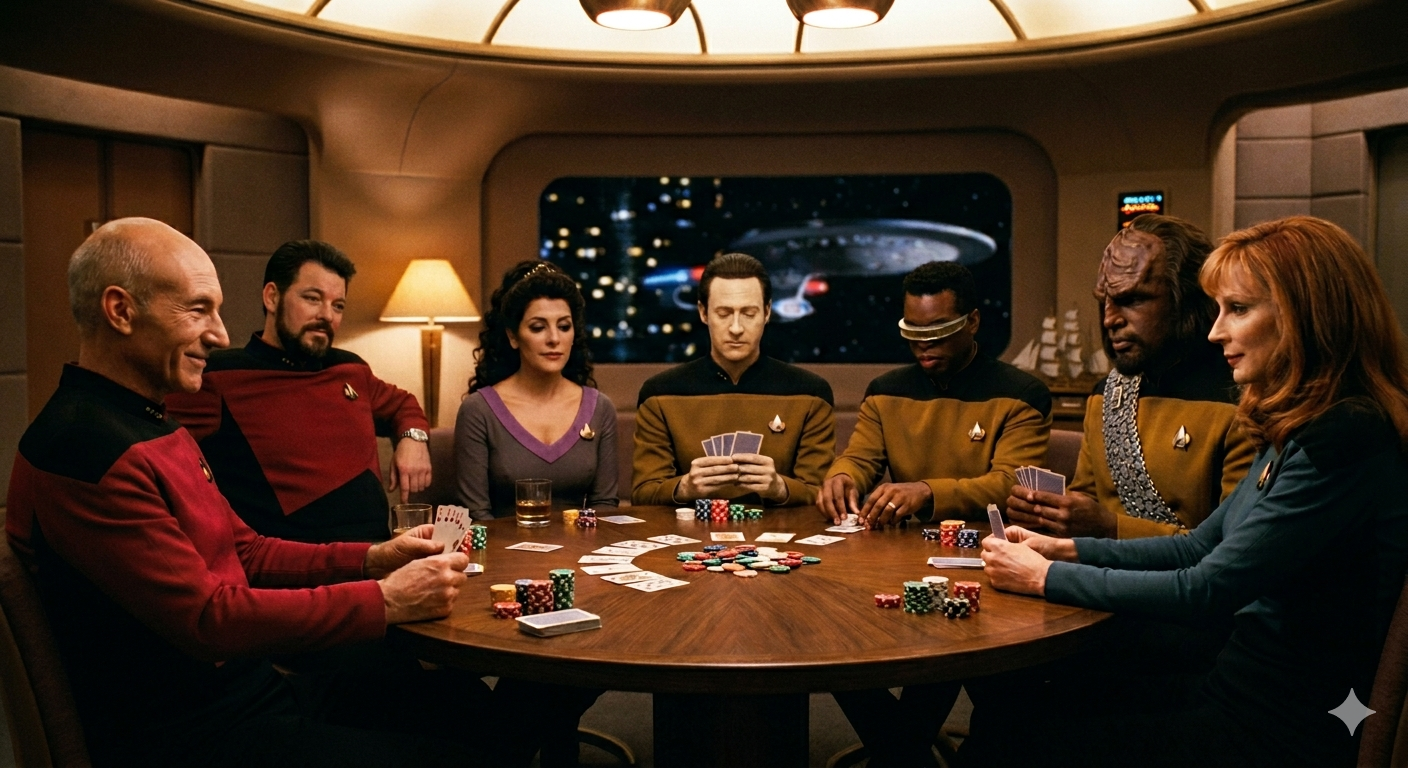
And I cannot say enough about the final scene. After Picard and his crew save the universe once again, the senior staff is blowing off steam with their ritual poker game. For the first time ever, Captain Picard enters Riker’s quarters and asks to join.
“I should have done this a long time ago,” he says.
Star Trek: The Next Generation ends not with the main crew on the bridge, and not with Picard waving his hand and saying “Engage,” but with these seven people—who essentially became a family—playing poker together.
That moment beautifully mirrored the real-life evolution of the cast. It’s been well-documented that during the first few months of season one, Patrick Stewart carried himself with a stiff, rigid, stereotypical British stage actor arrogance. He didn’t even unpack his suitcase for three months! He famously lectured the cast for fooling around on set, until he finally realized that they were professionals—they just knew how to let their hair down and have fun. Once he made that realization, he joined right in.
On screen, Jean-Luc Picard underwent the exact same transformation over seven seasons, growing from a rigid, distant commander who was uncomfortable around children into a man who finally pulled up a chair to join his friends.
Final Frontiers and Final Hurrahs
Interestingly enough, season three of Star Trek: Picard ended the exact same way. It was enormous fan service, but after the lackluster disaster of Star Trek: Nemesis left a bad taste in fans’ mouths for twenty years, we desperately needed a proper final hurrah. Around episode seven of Picard, I remember thinking, It would be really cool to end this series with another poker game. I wasn’t the only one.
When you look at all the Star Trek finales side-by-side, “All Good Things…” stands out as the one I can go back and watch over and over again. It stayed true to the characters and didn’t attempt to throw viewers any radical curveballs—aside from the sometimes-maligned and all-too-brief Worf-Troi coupling.
Don’t feel too bad, Worf. A few years after this, you’ll head over to Deep Space Nine and get to marry Jadzia Dax!
Rebuilding a life takes grit, consistency, and a lot of ‘Option C’ thinking. Whether I’m closing in on 1,000 consecutive days of blogging or reflecting on the decade of work that brought me here, the mission remains the same: No glitz. Just the work. New to the blog? Start your journey here to see the blueprint and the ‘Tricorder’ perspective behind the rebuild.
Thanks for stopping by Rebuilding Rob. Be sure to like 👍, comment and subscribe below. It’s greatly appreciated! Also, feel free to follow me on social media and check out my recent posts!
- Character Analysis: The Beauty of Being Messy
- Why The Handmaid’s Tale Terrifies Me More Than 1984
- The Most Mismarketed Movie of the ’90s: Pleasantville
- Episode 3.9 No More Glaciers in LIVE!
- The 26-Year Circle: On Anniversaries, Ghosts, and Learning to Live with the Scars
AI art created by Google Gemini 
The article “all good things really do come to an end” first appeared on Rebuilding Rob.


Leave a Reply