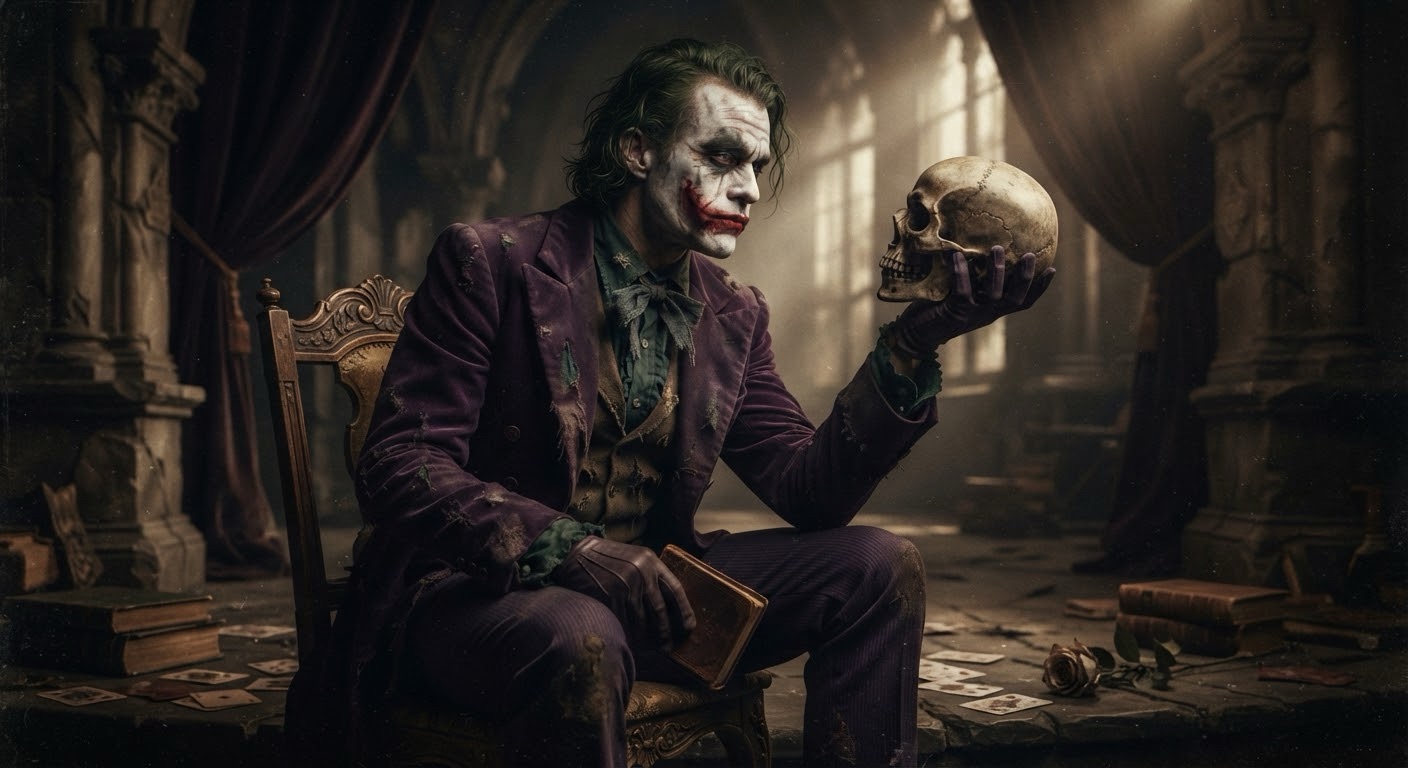


I think it’s a pretty widely accepted idea in literature, television, and movies that villains are generally more interesting characters—if only by virtue of the fact that we have to question the motivations that turned them toward evil. More often than not, compelling villains start out as decent people who had a bad experience that warped them toward the darkness.
Years ago, I read an idea—and admittedly, I kind of took it to heart—that next to Professor Moriarty from Sherlock Holmes, the Joker is the greatest fictional villain ever created. I don’t know how true that absolute ranking is, but like Batman, he is an incredibly multifaceted character. We’ve seen him played for laughs. We’ve seen him played as a buffoon. We’ve seen the homicidal artist, courtesy of Jack Nicholson in the 1989 Batman movie, and finally, we saw him as a terrifying domestic terrorist when Heath Ledger won the Best Supporting Actor Oscar for his performance in The Dark Knight.
To put it another way, if Batman is the Hamlet of comic books, the Joker is the Hamlet of comic book villains. Everybody wants to take their stab at the character—whether it’s writing him, drawing him, or playing him on television and in movies.
Now, the Joker’s origin has been a bit of a contentious point over the decades. Back in the early 1940s, it was revealed in the Batman comics that the Joker started out as a petty crook who donned the red hood, broke into a chemical factory, and found himself doused in chemicals that gave him his ghastly smile, pasty white skin, and green hair.
Back in 1988’s The Killing Joke, it was established that while the Joker tells this story, he prefers to think of his origin as “multiple choice.” This means the true motivation and the true origin of the character remain highly dubious at best and completely mysterious at worst. Is he simply chaos incarnate? Is he what happens when a good man has a bad day and gets pushed completely over the edge? Is he something in the middle? Is he both? Is he none of the above?
To keep pace with a character as complex as Batman, the Joker almost has to be this layered and multifaceted. Writers wanted to illustrate what a monster he has been over the decades, which is why so many great tragedies—like the fate of Barbara Gordon or Jason Todd—took place at his hands. Granted, Barbara eventually regained the ability to walk and Jason eventually returned from the dead, but I digress. Piling atrocity upon atrocity has a way of setting one villain head and shoulders apart from the rest of the rogues’ gallery.
How we got from silver-grade goofiness to modern psychological terror in the comics is a whole different rabbit hole, though—perhaps a conversation for another day.
Now, I wouldn’t go as far as to say that I like the Joker more than Batman. I don’t. But I do think that the Joker is the greatest fictional villain to ever come out of American popular culture in the 20th century. So, to answer the question as to whether or not I sometimes like the villain more than the hero, my answer is yes. While I don’t like the Joker more than I like Batman, I definitely like the Joker more than I like a lot of other hero characters.
Rebuilding a life takes grit, consistency, and a lot of ‘Option C’ thinking. Having crossed the 1,000-day milestone, I’m now charting the territory beyond. The mission remains the same: No glitz. Just the work. New to the blog? Start your journey here to see the blueprint and the ‘Tricorder’ perspective behind the rebuild.
Thanks for stopping by Rebuilding Rob. Be sure to like 👍, comment and subscribe below. It’s greatly appreciated! Also, feel free to follow me on social media and check out my recent posts
- Rob Ranks: Star Trek: Strange New Worlds, season 2
- Beating the Bell
- Out of the Woodwork
- Episode 3.8 Too Dumb To Quit is LIVE!
- Why Now? (And What Star Trek Got Wrong About First Contact)
AI art created by Google Gemini.
The article quote of the Hamlet of comic book villains, and” first appeared on Rebuilding Rob


Leave a Reply