Thanks to Eric Fulton for this writing prompt. For those of you who don’t know, he is the geo- tracking mastermind of Eric Fulton’s blog. If you haven’t had a look yet, check it out!
What’s something everyone else seems to love that you genuinely do not understand?
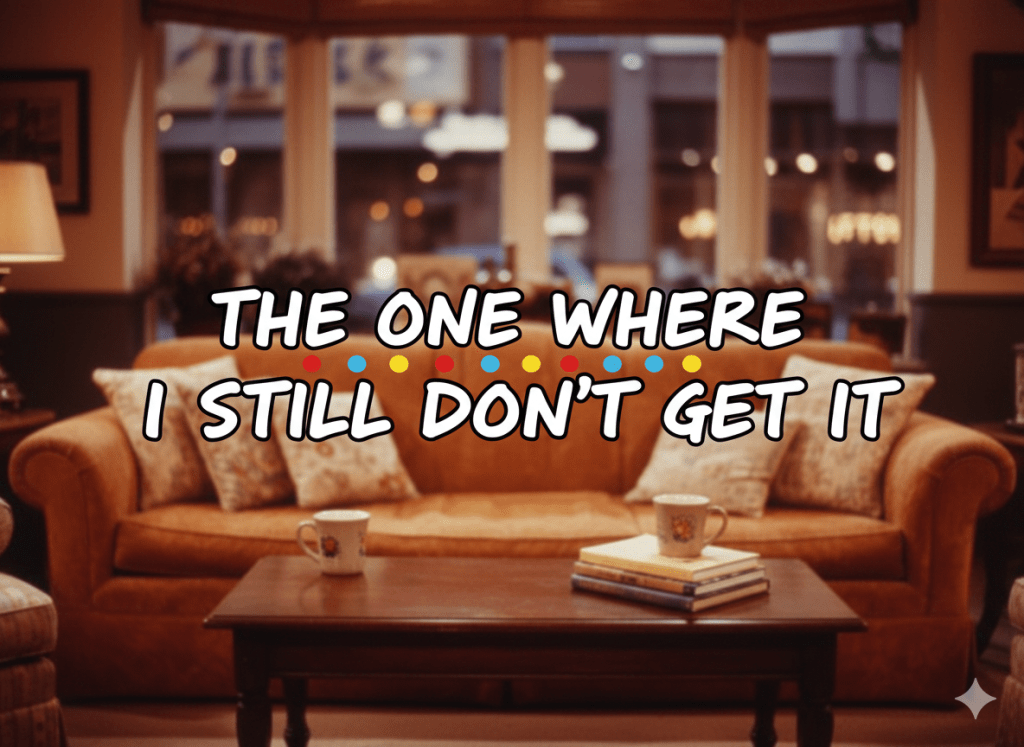
What’s something everyone else seems to love that you genuinely do not understand? For me, it’s the TV show Friends.
I’ve seen more episodes than I care to admit. I know the premise, the dynamics, and the character arcs. But even thirty years after its premiere, I’ve never found it funny. While it captured the cultural zeitgeist of 1995, I’ve always viewed it as a sanitized, Hollywood-glossed version of reality—a revamped Singles without the grit.
The Characters vs. Reality
The humor often felt static, even as the storylines matured. Ross struck me as an intellectual douchebag; Rachel was the high school “pretty girl” who never grew out of her ego; Monica was too neurotic to be tolerable in real life. I particularly felt for Chandler—the only character I liked—who seemed “neutered” once he was paired off with Monica.
Beyond the character tropes, the setting felt like a fantasy. These people lived in New York City for a decade and seemingly never encountered a person of color until Ayesha Tyler’s brief arc. Having spent time in the city myself, I know that’s an impossibility. It’s a glaring hole that even the creators have since admitted was a failure of perspective.
The “Platonic” Myth
The show eventually succumbed to the inevitable: everyone paired off. By the series finale, the “six single friends” had become three couples (minus Joey). I’ve discussed the debate of platonic friendship on this blog before, and while I maintain that men and women cannot be “just friends” long-term without complication, the show missed a real opportunity to explore that tension with nuance. Instead, it chose the easy Hollywood ending.
The Generational Gap
I remember my mother gushing over the show, saying, “This is just how it is with young single people.” I remember thinking, “No, it’s not.” By the end, they didn’t look like hungry, ambitious 20-somethings anymore; they looked like movie stars fully integrated into the Hollywood machine. Maybe that’s why I can’t connect with it. It represents a version of “potential” that felt manufactured—a breadcrumb of a life rather than the 100% reality I’m interested in documenting now.
Coming in Part 2: I’m digging deeper into the personal friction behind the screen. We’re going to explore why seeing Chandler get ‘neutered’ bothered me so much, and why my mother’s take on the show was the ultimate breadcrumb. Stay tuned for the real reason I can’t just ‘be friends’ with this show
Thanks for stopping by Rebuilding Rob. Be sure to like 👍, comment, and subscribe below. It’s greatly appreciated! Also, feel free to follow me on social media and check out my recent posts!
- Rob‘s 2026 Men’s’ March Madness bracket update – the National Championship
- Racing Against the Clock (One Meal at a Time)
- The 100% Policy: Why I Am My Own Twin Flame (And My Own Soulmate)
- Rob‘s 2026 men’s March madness bracket update – the final four
- The Person They’d Meet
AI art created with Google Gemini
The article “The One Where I Still Don’t Get It” first appeared on Rebuilding Rob.



 Rebuilding Rob
Leave a comment