

The Timelines of Tomorrow
Ive thought a few times on this blog before about my passion for outer space, the space program, and the very concept of space exploration in general. For the first time in a long time, I think I may very well live long enough to see humans set foot on Mars. I don’t know if I’ll live long enough to see a permanent Martian colony, but I think there is a distinct possibility I might see some sort of permanent lunar colony. And I use the term “permanent lunar colony” very loosely—it might be something akin to the International Space Station, which hasn’t been empty since late 2000.
I have to admit that I never gave a lot of these concepts of total isolation very much thought until the Artemis II mission started getting closer to reality. When they go around the far side of the moon, those astronauts will operate under radio silence for about 44 minutes. Imagine that—for nearly three-quarters of an hour, those humans will be completely isolated from every single other person on planet Earth, traveling further into space than any human being ever has. Exciting? Yes. Daunting? Absolutely. But the boldness of such an endeavor is what makes it so exciting
Living Under Glass: The Psychological “Option C”
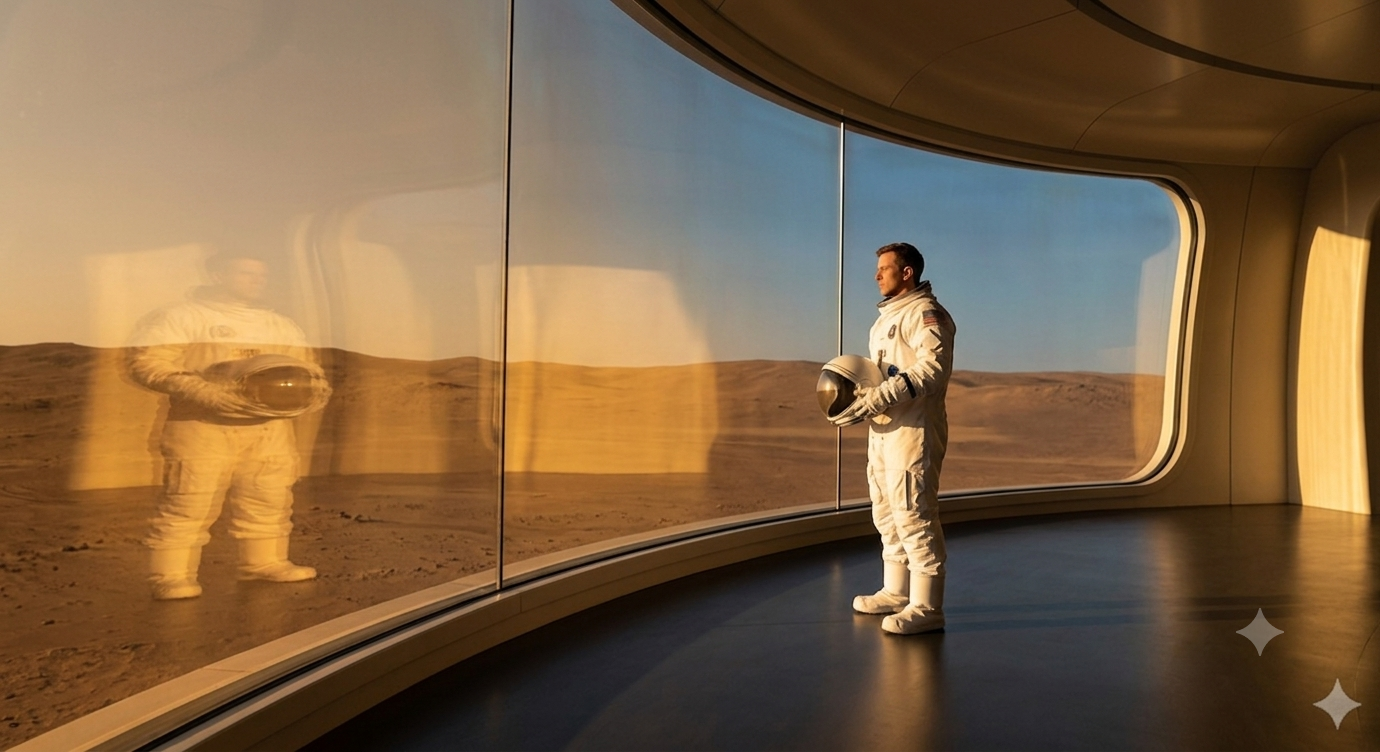
When people ask what life there would actually look like, I picture a beautiful, terrifying prison of engineering. I’ve always heard Mars referred to as “the Red Planet,” and every photo I’ve ever seen shows barren red rock and those same tan-ish, butterscotch skies. Scientists think that either life existed on Mars billions of years ago, or it’s billions of years away from supporting it naturally. Sure, there’s talk about traces of water or ice, but that’s not really much to look at. I’ve never understood the allure of living in Earth deserts like Las Vegas or Arizona, but at least there’s civilization and infrastructure there. Trying to conceptualize an entire planet as a barren desert is tough. There’s a certain stark beauty to it, I suppose, but the vibrant biodiversity of Earth takes the cake every time.
To choose to live in that isolation requires a psychological “Option C.” I think some people possess an extraordinary, almost unfathomable version of the human pioneering spirit, like that young woman who volunteered. Or, perhaps, some people feel like they have nothing waiting for them here on Earth.
The Backstory: In this recent piece, I dive deeper into why the dream of Mars felt shelved after the Challenger disaster, and how starting over at zero mirrors the final frontier.
It’s one thing to move to a new place. When I moved from Michigan to South Carolina for eight years, it felt pretty daunting to me. But I try to imagine the idea of leaving the literal planet—literally every single place you have ever been and every single person you have ever known, never to see them again
If I were 24, single, and had no kids, maybe I would feel differently about the prospect of leaving. But I’m 52 with two kids, a lifetime of memories here, and fewer days ahead of me than I have behind me.
The Hero’s Journey Ends at Home
For me, part of what makes exploration so great is being able to come home. Think about every classic “Hero’s Journey” story ever told—The Odyssey, The Lord of the Rings, even Finding Nemo. All of these stories end with our heroes returning home. Usually, you return a different person—better, more worldly, wiser, with more experiences under your belt. Part of the adventure is the return trip. Otherwise, you aren’t on a quest; you’re just permanently relocating.
As far as a timeline for actual colonization, I think that will take centuries. It would have to become a multigenerational effort where people decide to have children there and raise families in a world under glass. We won’t see that anytime soon.
Still, I take a lot of solace in human potential. There was a span of just 66 years between the Wright brothers’ first flight and Apollo 11 putting humans on the moon. That is an extraordinary testament to what we can do. I’m hopeful I will see human footprints on Mars in my lifetime, but the colony itself belongs to the distant future.
It’s summer here in the northern hemisphere, and I’m loving every second of it. Baseball season is in full swing, the school year is over, and I currently have both of my boys with me. As I write this, I’m driving down the road with the windows down, feeling the sun beating down on my skin. I know that if I stay out too long, I’ll get sunburned. But at least I get to experience the sunburn. This is the kind of visceral, raw human stuff that one simply could not experience living inside a pod on Mars.
I guess I would sum up my thoughts about living on the Red Planet the same way people sum up their feelings about visiting far-away cities: it’s a great place to visit, but I wouldn’t want to live there.
Rebuilding a life takes grit, consistency, and a lot of ‘Option C’ thinking. Having crossed the 1,000-day milestone, I’m now charting the territory beyond. The mission remains the same: No glitz. Just the work. New to the blog? Start your journey here to see the blueprint and the ‘Tricorder’ perspective behind the rebuild.
Thanks for stopping by Rebuilding Rob. Be sure to like 👍, comment and subscribe below. It’s greatly appreciated! Also, feel free to follow me on social media and check out my recent posts!
- The 2019 Files: Why I Wouldn’t Change a Thing (Except When I Would)
- Rob Reviews: Star Trek Strange New Worlds 4.7 – Like Chronitons Through the Hourglass
- Camping, Meeting Dad, and the Art of the Buffer Day
- What My Parents Didn’t Teach Me
- Five mobile apps I can’t live without 
AI art created by Google Gemini
The article “The Final Frontier is Home: Why Every Hero’s Journey Ends Here” first appeared on Rebuilding Rob.

Leave a Reply