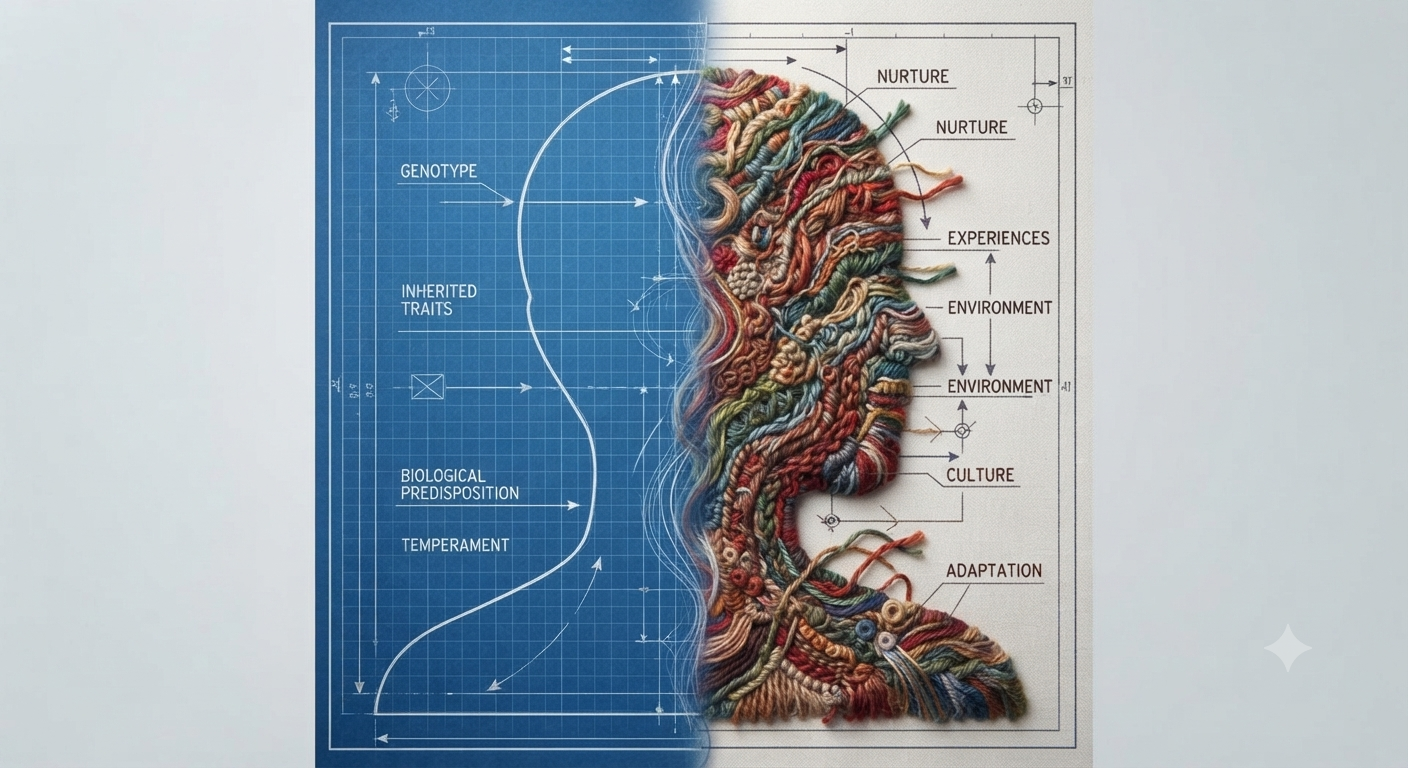
Do you think we’re shaped more by our experiences or by who we are?
My short answer—because I’m not entirely sure what the prompt implies by “who we are”—is that we are defined by the accumulation of our experiences. But when we start dissecting that question, we land squarely in the nature versus nurture debate. While the phrase was coined by Sir Francis Galton in 1874, the theory—the tension between our innate biological blueprint and the environment that shapes us—is as old as Ancient Greece.
The Science of Us
In this context, “nature” refers to our genetic makeup—the biological inheritance that dictates temperament and physical traits. “Nurture” refers to our environment—everything that happens to us after birth, including our upbringing, social relationships, and cultural influences.
In modern psychology, the consensus is that we aren’t just one or the other. We are an interaction of both;
the Phenotype = Genotype + Environment.
Our genes provide the blueprint, but our experiences are the construction crew that decides how the building actually looks.
Inherited Blueprints
I see this playing out in my own life every day. On the “nature” side, I carry the blueprints of my parents. I find myself using specific inflections in my voice that I never consciously adopted; they just appeared—a phantom echo of my father. I picked up his informal way of approaching strangers, and I certainly absorbed the ambient anxiety of living with a high-strung mother.
But then there is the “nurture”—the environment that forced me to adapt. There is a deep irony in inheriting a high-anxiety environment, because most people today describe me as a very laid-back guy. I had to become that way. I learned long ago that I couldn’t afford to sweat the small stuff, a direct counter-reaction to the perpetual state of panic I witnessed growing up.
Breaking the Cycle
That is where the real work happens. So much of growing up is carving out an identity, and while heredity provides the raw materials, there comes a moment where you have to decide: are you going to continue the cycle, or are you going to break it?
I spent years feeling like the black sheep. Sometimes that was literal—being the only redhead in a family of dark-haired and blonde relatives—but mostly it was ideological. While the rest of my family gravitated toward conservative politics, I found myself moving in the opposite direction. For years, sitting in living rooms with the television tuned to Fox News, I was told, “It’s okay, Robbie. You’ll become conservative when you’re older.”
I now realize those predictions were less about biology and more about projection—a desire for me to mirror their own worldview. It’s fascinating to compare that to my friend Sierra, whose parents were “former hippies.” We arrive at many of the same political conclusions, yet we came from completely different starting points. It’s a reminder that while our origin stories shape our initial trajectory, they don’t dictate our final destination.
It’s also an odd experience navigating the world with my particular demographic. As a white, heterosexual male, I often see people breathe a visible sigh of relief when I express my political views. There is that brief, telling moment where they realize, “Oh, it’s okay. He’s one of us.”
That, perhaps, is the ultimate point. My identity isn’t just the blueprint I inherited, nor is it just a byproduct of the “nurture” I received; it is the conscious, daily work of deciding which parts of my history to carry forward, and which parts to leave at the door.
The Great Experiment
Of course, all this talk of blueprints and builders leads me to my own “great experiment”: raising Kid 1 and Kid 2. I’ve learned that my role isn’t to force them into a specific mold, but to provide an environment where they have the leeway to flourish.
With Kid 1, I’ve watched him navigate his own path—piercings, choices, and all. I don’t have to like every choice he makes to respect his right to make them. With Kid 2, I’m seeing the process unfold in real-time. I can see bits of my personality and bits of X2’s being woven together to create his framework. Humans are an incredible tapestry where genetics and experience are inextricably linked, and there is no telling exactly how a person will turn out. The best I can do is offer the space for them to weave their own design, and hope that when they look at their own blueprint, they feel empowered to build something entirely their own.

Building an Empire
At 10:00 eastern time, we’re tearing down the ‘tomb’ of the past and building an empire on our own terms. Join me for a deeply personal look at finding sovereignty in the Serengeti.
“Building an Empire”—Episode 3 of Rebuilding Rob: The Podcast—drops later today on Spotify, YouTube, and wherever you get your podcasts.
Rebuilding a life takes grit, consistency, and a lot of ‘Option C’ thinking. Having crossed the 1,000-day milestone, I’m now charting the territory beyond. The mission remains the same: No glitz. Just the work. New to the blog? Start your journey here to see the blueprint and the ‘Tricorder’ perspective behind the rebuild.
Thanks for stopping by Rebuilding Rob. Be sure to like 👍, comment and subscribe below. It’s greatly appreciated! Also, feel free to follow me on social media and check out my recent posts!
- Airport Dynamics: Why Myrtle Beach Wins and Atlanta Loses
- The Tropes That Refuse to Die
- The 2019 Files: Why I Wouldn’t Change a Thing (Except When I Would)
- Rob Reviews: Star Trek Strange New Worlds 4.7 – Like Chronitons Through the Hourglass
- Camping, Meeting Dad, and the Art of the Buffer Day
AI art created by Google Gemini
The article “the blueprint and the builder“ first appeared on Rebuilding Rob.

Leave a Reply