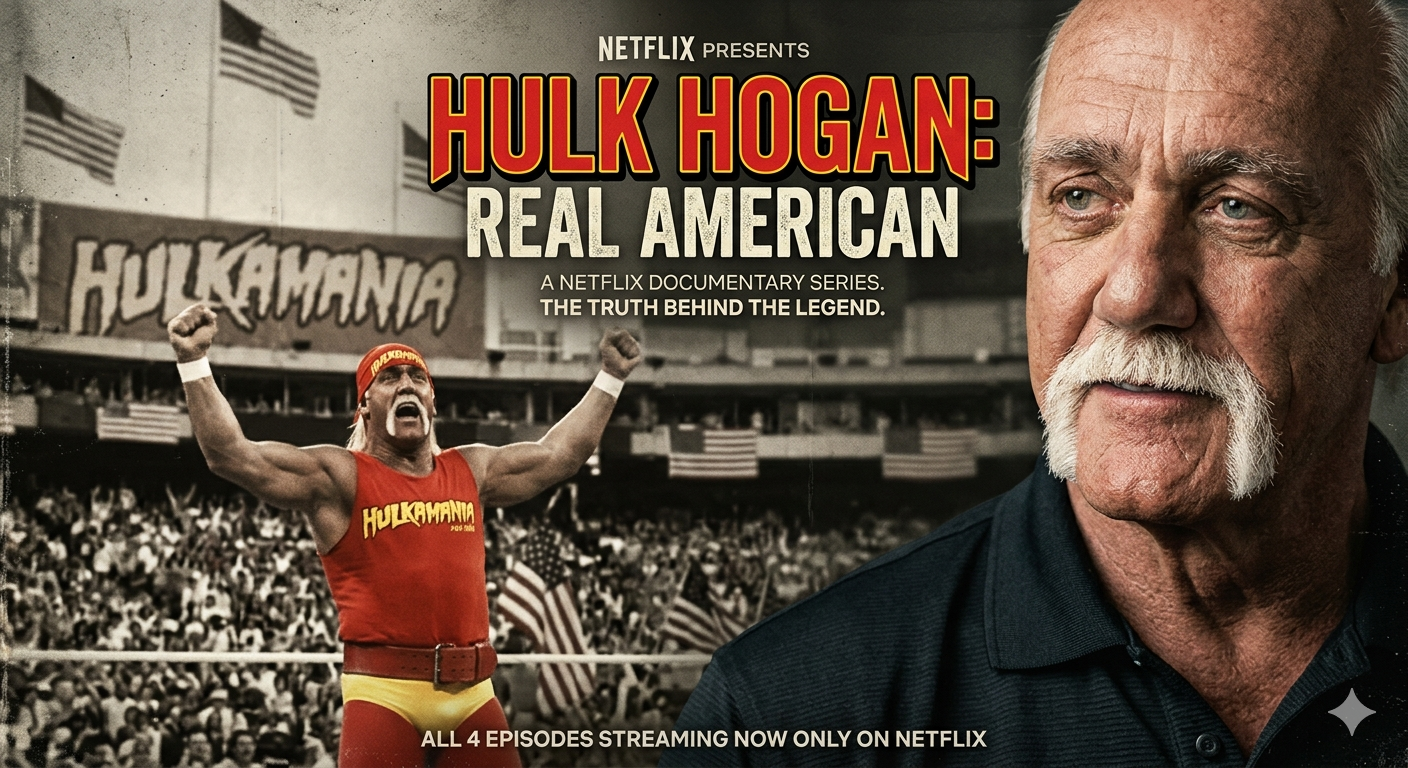
I’ve been avoiding the new Netflix documentary, Hulk Hogan: Real American, for several reasons. First and foremost, I was concerned it would be a fluff piece. With footage provided by WWE and the involvement of the Hogan estate, I figured it would be a polished, one-sided narrative.
Beyond that, I worried about the depiction of events. Anyone who follows pro wrestling knows Hogan’s “backstage legacy” involves being a bit of a pathological liar. He’s known to stretch and manipulate the truth—or concoct total nonsense, like the claim that Metallica wanted him to play bass, or the story from his reality series Hogan Knows Best where he allegedly missed the call for the George Foreman Grill.
As a child of the 80s who grew up on “The Golden Era,” I’ve learned a lot about the business behind the curtain. It was Hogan who reportedly alerted Vince McMahon to Jesse Ventura’s attempt to unionize. He was notorious for “protecting his spot,” nixing any storylines he didn’t approve of in both WWE and WCW. Then, of course, there is the infamous recording of him using racial slurs.
Despite my reservations, I broke down on Thursday and started watching at the suggestion of X2. Here is my breakdown of the four-part series.
The Observations
Part One: The Foundation
Episode one covers Hogan’s early life and his relationship with his father, which Hogan flatly describes as abusive. It tracks his early musical aspirations and the realization that, while he was naturally a fan of wrestling, he wanted to be in the ring. It jumps through various personas—The Super Destroyer, Terry Boulder, Terry “The Hulk” Boulder—before finally landing on Hulk Hogan.
I found it interesting that his ex-wife, Linda, played a significant role here, though his daughter Brooke is nowhere to be seen. It reminds me of how Ozzy’s eldest daughter opted out of The Osbournes; sometimes the legal or personal ramifications of participation just aren’t worth it for the family.
Part Two: The Phenomenon
This part covers the prime years, beginning with his marriage to Linda and the January 23, 1984, title win over the Iron Sheik. The film spins the narrative as if the Iran Hostage Crisis was still ongoing in ’84 (it ended years prior), which shows the creative autonomy the filmmakers took with the “truth.”
We see the famous clip of Hogan putting Richard Belzer to sleep on live TV and a surprisingly somber look at Hogan’s estranged brother. We also see Hogan’s ego on full display, as he still clearly believes he is the greatest to ever do it. While I could have done without the Donald Trump segments, the “Self-Destruction of the Ultimate Warrior” style burial in this episode was fascinating to watch.
Part Three: Hollywood and Hubris
The third part explores the fallout of the WWE steroid scandal and Hogan’s “retirement.” The ego remains unchecked—Hogan actually claims he got Arsenio Hall his job.
However, I was impressed by the frank discussion regarding the debacle of WrestleMania IX. While Bret Hart can sometimes sound like an old man yelling at clouds, his grievances here feel totally appropriate. The documentary is surprisingly honest about Hogan’s lackluster movie career and his failed aspirations to become a partial owner of the company.
Part Four: Hulk vs. Terry
This is easily the darkest segment. It captures the moment Father Time caught up with the man. The documentary acknowledges his affair with a friend of Brooke’s and the brutal Rolling Stone interview where Hogan made the infamous “OJ” comment.
From the prescription of fentanyl to the Gawker sex tape lawsuit and the subsequent racial slur scandal, the film doesn’t shy away from the “scars and warts.” It ends with his final WWE appearance, where he tries to frame the crowd’s genuine disdain as “bad guy heat.” Like so many wrestlers, he clearly struggles to separate Terry Bollea from the Hulk Hogan character.
The Verdict
I didn’t write this review to eulogize the guy—I actually handled that in a separate post shortly after he passed. Instead, I wrote this to critique the documentary and how it handles such a complicated legacy. All in all, I have to say I’m pretty happy with the job they did. There may have been certain things that were embellished slightly, but I also feel like they definitely shined a light on Hulk Hogan’s scars and warts as well. This documentary certainly did nothing to change my opinion about Hulk Hogan, one way or the other. The truth is, I don’t think that was the intention of the creators.
Hogan remains one of the most recognizable people in the world—the “Babe Ruth” of wrestling who paved the way for the likes of The Rock, John Cena, and Dave Bautista. Whether you are a “wrestling junkie” or just interested in a study of a flawed human being, I would recommend giving this a watch.
Hulk Hogan: Real American is currently streaming on Netflix
Rebuilding a life takes grit, consistency, and a lot of ‘Option C’ thinking. Whether I’m 900 days into a streak or reflecting on the decade of posts that led me here, the mission remains the same. New to the blog? Start your journey here to see the blueprint behind the rebuild
Today’s post is inspired by the WordPress Daily Prompt. While I’ve taken the topic in my own direction for the Road to 1,000 Days, you can find more responses to today’s prompt HERE.
Thanks for stopping by Rebuilding Rob. Be sure to like 👍, comment and subscribe below. It’s greatly appreciated! Also, feel free to follow me on social media and check out my recent posts!
- The Rebuilding of Nog
- What It Really Means to Be a Good Person
- No Resolution is Your Resolution
- Where to Next? (And Why It’s Italy)
- Writing for Algorithms to Reach the Humans
AI art created by Google Gemini
The article “Rob Reviews: Hulk Hogan: Real American” first appeared on Rebuilding Rob


Leave a Reply