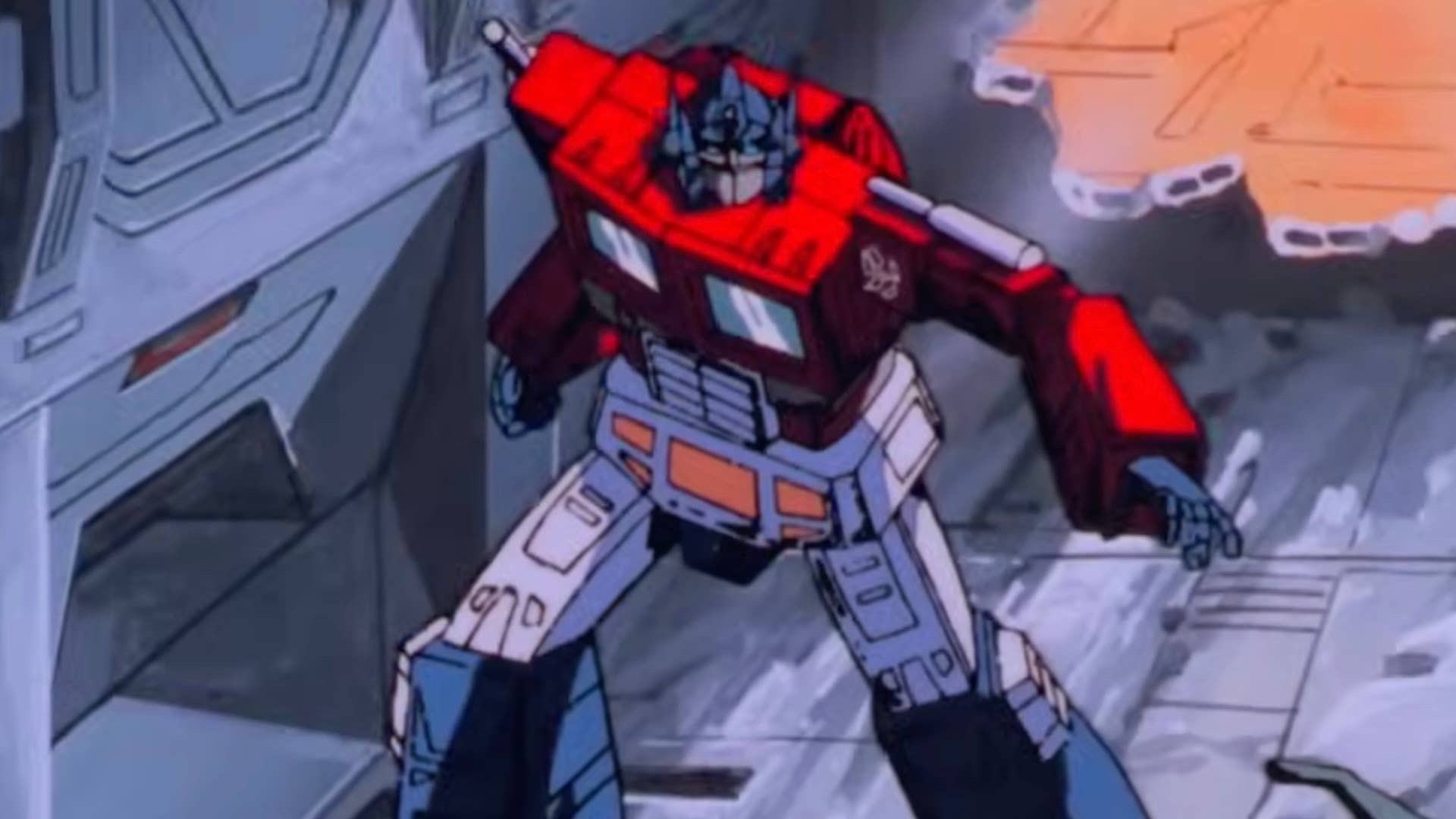
August 8th actually marked the official 40th anniversary of the release of 1986’s The Transformers: The Movie. To commemorate this milestone, the film recently returned to theater screens, accompanied by a brand-new animated short titled “The Awakening.”
While I didn’t quite make it out to the theater for the theatrical re-release, I did manage to check out “The Awakening” online. As such, I figured a retro review of this animated classic was long overdue.
The Setup
I was 12 years old in the summer of 1986, and the Transformers were as big a part of my life as G.I. Joe or Masters of the Universe. As much as I was into the animated series, the toys, and the Marvel comic book, the definitive voice, version, and aesthetic of the 1980s Transformers toy line will always be the cartoon. Naturally, the movie was required viewing.
Yes, even as a kid, I knew the animated series was essentially a 30-minute commercial designed to sell toys, just as the Marvel comic was a 22-page advertisement. But knowing you’re watching an extended commercial and understanding the ruthless business edict of “out with the old, in with the new” are two totally different things.
In 1980s children’s television, cartoons portrayed violence, but rarely its consequences. The good guys always won. The bad guys—while somewhat of a threat—were ultimately portrayed as buffoons who tried to take over the world and failed week after week.
The Transformers, however, was different. You actually saw the robots get shot, injured, and dismantled. There was a genuine element of life and death to it, even if the good guys ultimately came out on top. The Transformers: The Movie took everything we thought we knew about the tropes of 80s animated television and set those tropes on fire.
Everything was bigger. The 16:9 widescreen format opened up an entirely new world for the characters. Young people today need to keep in mind that in the 80s, televisions were square with a 4:3 aspect ratio; it wasn’t until the advent of HDTV in the 2000s that widescreen made its permanent leap from the theater to our living rooms.
The Plot
The movie is essentially the franchise’s retelling of the classic Fantastic Four “Coming of Galactus” story arc. Out there in space is a giant mechanical planet known as Unicron who consumes other worlds, and he’s making his way toward Cybertron, the birthplace of the Transformers.
A quick narrative prologue tells us the year is now 2005. The Decepticons have conquered Cybertron, while the Autobots continue to fight back from Autobot City on Earth’s moon, though they are lower on Energon than ever. During a routine shuttle run to Earth, Megatron and his henchmen hijack the vessel and, within the span of about three minutes, murder half a dozen Autobots—and the collective childhood of my generation.
Oh my God, they’re dying! And what is this hair metal music playing in the background?
Before we knew what hit us, Ironhide, Ratchet, Prowl, and Brawn were all gone.
The Decepticons use the hijacked shuttle to infiltrate Autobot City, launching a devastating assault. The Autobots are fighting valiantly, just barely holding the line, when a shuttle of reinforcements led by Optimus Prime arrives. Prime makes his way into the fray and issues that faithful decree: “Megatron must be stopped. No matter the cost.”
What follows is Optimus Prime’s legendary last stand in a brutal fight to the death with Megatron. Thanks to the meddling of that punk Hot Rod, Prime is fatally wounded. The Decepticons flee, but it is a pyrrhic victory.
The next scene is a moment that has haunted people of my generation for the last four decades: Optimus Prime dies, passing the previously unseen Matrix of Leadership to his friend Ultra Magnus. Like millions of other Transformers fans, I was too shocked, disappointed, and angry to even fully process the rest of the movie.
In the years that followed, the creators of both the series and the movie would concede that they simply had no idea how important Prime had become to the fans. He would ultimately be resurrected the following season on the show, but that’s beside the point.
Meanwhile, a floating, damaged Megatron drifts through space and encounters Unicron, who offers him a deal: become his property and destroy the Autobot Matrix of Leadership in exchange for a new body. Megatron is reformatted into Galvatron—a higher-tech, deadlier version of his former self.
Under Galvatron’s command, the newly powered Decepticons regroup and attack Autobot City once more, forcing the surviving heroes to flee. Ultimately, the Autobots crash-land on Junkion, a planet covered entirely in mechanical junk and inhabited by eccentric scavenger robots.
Galvatron eventually overpowers Ultra Magnus—who admits by his own admission that he is no leader—and takes possession of the Matrix to deliver to Unicron. Reassembled by the Junkions, Hot Rod and the remaining Autobots realize they must retrieve the Matrix and destroy Unicron before he consumes Cybertron.
Back on Unicron, Galvatron tries to use the Matrix to control the planetary behemoth, only to be horrified when it is revealed that Unicron is a transformer—the mother of all transformers. The entire planet transforms into an enormous robot, swallows Galvatron whole, and marches on Cybertron.
The Autobots arrive at Cybertron and split up across the massive mechanical world. Hot Rod crosses paths with Galvatron, and the two engage in a fierce one-on-one duel. Just as Galvatron is on the verge of crushing him, Hot Rod reaches for the Matrix of Leadership. He is engulfed in a surge of blue light, and the voice of Optimus Prime echoes out: “Arise, Rodimus Prime.”
The newly reborn Rodimus Prime easily defeats Galvatron, casts him out into space, and flings open the Matrix. Its radiant power detonates Unicron from the inside out. With the threat neutralized, the Autobots finally retake Cybertron under the command of their new leader, Rodimus Prime.
Of course, back in 1986, I and countless other Gen X kids were still sitting in the theater thinking, “Yeah, but Optimus Prime is still dead.”
My take
This is an unusual movie to critique because my impressions are burned so deeply into my mind from when I was 12 years old. As noted, it’s essentially a sci-fi blockbuster built to clear out old inventory and sell new toys.
As a fan, I never quite understood the jarring time jump from 1986 to 2005. However, I’ve since learned there were two primary factors behind it: first, getting rid of legacy characters to make shelf space for new ones; and second, a creative desire by the showrunners to break away from repetitive “Megatron tries to steal Earth’s energy” plots and expand the scope into outer space.
One could watch The Transformers: The Movie as a standalone event today, but the emotional and cultural impact—particularly the loss of beloved characters like Optimus Prime—would be entirely lost without context. For years, I owned a bootleg VHS copy of the film before eventually buying it on DVD as a remastered special edition decades later.
As a kid, I actually enjoyed the expanded cosmic scope of Season 3 that followed the movie, though I had zero emotional investment in the new characters. Sure, Optimus Prime was eventually resurrected in the two-part season finale, “The Return of Optimus Prime,” but by then, the emotional damage had been done. I was 12, and my interests were already beginning to shift.
As for “The Awakening,” the new animated short included in the 40th-anniversary release, it seems to be a mixed bag among fans. Essentially, it serves as a bridge representing Optimus Prime’s transition from the living world to the afterlife, emphasizing that the fight against evil will always continue. Notably, it’s the first time the fiercer Japanese iterations of Optimus Prime (such as Convoy) were explicitly referenced in an American animated sequence, neatly bridging the gap between the two franchises with the message that some version of Prime will always rise to lead.
While some fans online interpreted the short as the studio coldly saying, “He’s dead, get over it,” that really wasn’t my take at all.
Ultimately, “The Awakening” serves as a fitting final performance for the original voice of Optimus Prime, Peter Cullen, who breathed life into the character across the 80s series and later returned for Michael Bay’s live-action films.
I’ve argued before on this blog that Peter Cullen gave Optimus Prime a soul. He gave the character a conscience, a moral compass, and—as goofy as it may sound—made him one of my lifelong role models. Cullen infused the character with the philosophy of “be strong enough to be gentle,” a guiding ideal I’ve written about at length here.
I would easily recommend the movie. For fans of the franchise, it is absolute essential viewing just to understand the cultural touchstone of Generation 1. I’d even recommend it to fans of pure 80s nostalgia. It was a fascinating turning point that reinforced a hard truth we all learn eventually: the world doesn’t always function the way Mom and Dad said it did.
Rebuilding a life takes grit, consistency, and a lot of ‘Option C’ thinking. Having crossed the 1,000-day milestone, I’m now charting the territory beyond. The mission remains the same: No glitz. Just the work. New to the blog? Start your journey here to see the blueprint and the ‘Tricorder’ perspective behind the rebuild.
Today’s post is inspired by the WordPress Daily Prompt. While I’ve taken the topic in my own direction for the Road beyond 1,000 Days, you can find more responses to today’s prompt HERE.
Thanks for stopping by Rebuilding Rob. Be sure to like 👍, comment and subscribe below. It’s greatly appreciated! Also, feel free to follow me on social media and check out my recent posts!
- The victory lap
- What AI thinks of Rebuilding Rob
- The Halloween Pass
- Rob Ranks Star Trek: Strange New Worlds, season 3
- The Best Online Course I Never Wanted to Take
The article “Rob’s Retro Review – Transformers: The Movie (1986)” first appeared on Rebuilding Rob


Leave a Reply